







By using this site, you agree to the Privacy Policy and Terms of Use.
Accept
HelloozHellooz
Notification Show More
Latest News
CAQA Recruitment – The current job vacancies
News
Australian gov’t to review HE in long-term plan
News
Australia declined 50% of student visa applications from India in 2022
News
New Victoria University program gives high school leavers ‘space’ to figure out future
News
Fee-free TAFE and VET places for South Australians – Ai Group comment
News
Aa
  • Home
  • Education
    EducationShow More
    What kind of leader should you become?
    October 24, 2022
    What it takes to become a successful strategic learner
    October 24, 2022
    Instructional strategies: what are they?
    October 24, 2022
    Pandemic-related drop in enrolments and delays in student visa approvals causing chaos for RTOs
    August 12, 2022
    In their first meeting since the election, education ministers face a ‘massive’ teacher shortage
    August 12, 2022
  • VET Sector
    VET SectorShow More
    What are the plans for improving the vocational education and training sector – what are we missing?
    October 24, 2022
    A message from the CEO (October 2022)
    October 24, 2022
    Message from the CEO (12 August 2022)
    August 12, 2022
    In vocational education and training, what is assessment?
    August 12, 2022
    Competency-based assessments (CBA) and competency-based training (CBT): purpose and benefits
    August 12, 2022
  • HEP Sector
    HEP SectorShow More
    RPL – What you need to know
    October 24, 2022
    13th Anniversary of Career Calling
    August 12, 2022
    CAQA Resources’ process for developing assessment and learner resources
    August 12, 2022
    Writing an RPL assessment
    August 12, 2022
    Why should you trust CAQA Resources as your RTO training resource provider
    August 12, 2022
  • School Sector
    School SectorShow More
    Management of operational risks in training organisations
    October 24, 2022
    Strategies on how to promote your training organisation to international students
    October 24, 2022
    Creating a work environment that values employees
    October 24, 2022
    Continually reviewing, improving and self-assurance
    October 24, 2022
    The purpose of due-diligence audits
    August 12, 2022
  • Australia
    AustraliaShow More
    During the IHEA Dual-Sector Network conference, Sukh Sandhu addressed issues and changes in the VET sector.
    August 12, 2022
    ASQA’s as a national training package assurance body
    July 17, 2022
    A database of cheating websites has been updated through intelligence sharing.
    July 17, 2022
    An ASQA initiative called Pathways and Perspectives has been launched
    July 17, 2022
    What to do when legislation changes.
    June 27, 2022
  • World
    WorldShow More
    CAQA Systems Services
    January 31, 2022
    CAQA Recruitment
    January 31, 2022
    Online Media Solutions (OMS) Services
    January 31, 2022
    Effective feedback in both in-person and remote/virtual contexts
    November 1, 2021
    The importance of constructive feedback
    November 1, 2021
  • Science & Tech
    Science & TechShow More
    The purpose of due-diligence audits
    August 12, 2022
    Set boundaries, establish guidelines, and work within them.
    June 27, 2022
    Message from the CEO
    October 14, 2021
    Why organisations should prioritise systematic continuous improvement as a strategic priority
    October 14, 2021
    Converting the audit quality practices to system-centred rather than individual-auditor-centred
    September 19, 2021
  • Health
    HealthShow More
    VET ministers get moving on new quals and workforce
    October 24, 2022
    Graduate visas just papering over the skills gap
    October 24, 2022
    Visa processing way better but Claire Field warns there’s a problem for VET
    October 24, 2022
    The Smart and Skilled program for 2023-24 and its application process
    October 24, 2022
    2022 Skills Priority List almost doubles occupations with skills shortages
    October 24, 2022
  • Sports
    SportsShow More
    Differentiating instruction – Planning lessons based on different learners’ needs
    October 24, 2022
    The Instructional Design Process – The Five Steps
    October 24, 2022
    In vocational education and training, what is assessment?
    August 12, 2022
    Principles of assessment
    August 12, 2022
    Rules of evidence
    August 12, 2022
  • More
    • TV
    • Movies
Reading: Formative vs Summative Assessment: A Comparison
Share
Aa
HelloozHellooz
Search
  • Home
    • Home News
    • Home 2
    • Home 3
    • Home 4
    • Home 5
  • Categories
  • Bookmarks
    • Customize Interests
    • My Bookmarks
  • More Foxiz
    • Blog Index
    • Sitemap
Have an existing account? Sign In
Follow US
Hellooz > Blog > Training and Assessment > Formative vs Summative Assessment: A Comparison
Training and Assessment

Formative vs Summative Assessment: A Comparison

Vijay
Last updated: 2022/01/31 at 11:35 AM
Vijay Published January 31, 2022
Share
SHARE


Formative and summative assessment, the two main types of assessing knowledge and skills, are often confused with one another. Both types of assessment have a place in the teaching and learning process, but it can be difficult to distinguish between formative and summative assessment.
Both formative and summative assessments are used to assess learning, provide feedback to students and collect information for the purposes of future planning. Therefore, it is important to understand the differences and their purposes in education and training.
Assessment is defined as the process of collecting, analysing and evaluating information about a student for educational purposes.
Assessment involves gathering evidence to understand where a student is in their learning journey and what they know and don’t know, as well as how to improve the quality of what the student is learning.
When planning a lesson or teaching session, what kind of assessment strategy, formative or summative, should you use?
Formative assessment (FA) is ongoing during the learning process, and provides feedback for improving instruction.
Summative assessment (SA) is characterised as a one-time event used to make a judgment or decision about a student’s knowledge or skills.
The main difference between these two types of assessments lies in how the information is used by the trainers/assessors.
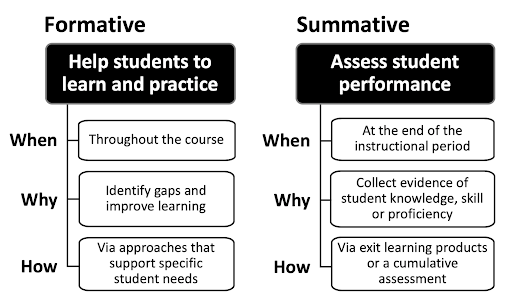
Formative assessments, also known as formative evaluation (FE) , occur while the student is studying. Formative assessment measures the student’s progress throughout the learning process and provides immediate feedback to help the student improve skills. These assessments give trainers and assessors feedback on how well the students understand what they have been taught so far, and is an ongoing process throughout a teaching session or unit of study. The goal of formative assessment is to identify what each learner knows and does not know so that teaching can be customised accordingly. Some examples of formative assessments are quizzes, observations, homework, classwork, exit surveys, discussions in class, turning in research for early feedback, classroom polls, creating diagrams and charts such as Venn diagrams, T/charts and so on. The purpose of formative assessments is usually to improve student’s learning. The formative assessments consider evaluation as a process.
A summative assessment is the end assessment, meaning it occurs at the very end of a course or curriculum unit. It measures everything that the student has learned throughout the study period – not just one lesson – and also shows how much they have improved or mastered specific skills. A summative assessment results is a grade or other evaluation that determines the placement, advancement or competency of a student. This type of assessment generally does not provide feedback for improvement; rather, it is an endpoint from which to decide where the student stands with regards to meeting objectives set by the assessor. A summative assessment is usually based on certain standards and criteria that evaluates the student’s learning related to a training product. Some examples of summative assessments include end of unit/term assessments, end of unit portfolios, standards-based assessments, final projects or papers and so on. The purpose of summative assessments is usually to evaluate the student’s achievements and performance. The summative assessments consider evaluation processes as an end product.
The main difference between formative and summative assessments:

In addition, there is a significant difference between the assessment strategies in terms of obtaining reliable information about the student’s learning.
Formative assessments are used to determine if a student requires additional assistance by closely monitoring the learning process.
Summative assessments offer competency to students. It tells you whether a student has met the learning objectives based on performance.
The purpose of the assessment process
During the formative assessment, the goal is to help students enhance their overall learning. It is necessary to be able to provide meaningful feedback in order to do this.
In formative assessment, the evaluation takes place numerous times throughout the learning process, whereas with summative assessment, the evaluation takes place at the conclusion of a unit of competency or course. This also explains why the assessments may have different size and duration of completion.
The formative assessment covers only a small number of curriculum areas. For instance, a small set of questions based on one element from a unit of competency.
In summative assessment, the goal is to determine how well a student has done academically.
Decide whether or not you want your students to be the best at something, or whether you want them to transcend themselves each and every time they take part in it.
The summative evaluation comprises the evaluation of entire chapters or content areas in a unit of competency. For example, at the end of a unit of competency, there may only be one evaluation. Therefore there will be a number of assessments included when students are doing their summative assessments.

You Might Also Like

Differentiating instruction – Planning lessons based on different learners’ needs

The Instructional Design Process – The Five Steps

In vocational education and training, what is assessment?

Principles of assessment

Rules of evidence

Vijay January 31, 2022
Share this Article
Facebook Twitter Email Print

Follow US

Find US on Social Medias
Facebook Like
Twitter Follow
Youtube Subscribe
Telegram Follow

Weekly Newsletter

Subscribe to our newsletter to get our newest articles instantly!

Popular News
News

The Victorian Chamber of Commerce and Industry survey unveiled Victoria as the most difficult state in Australia to do business in.

Vijay Vijay February 20, 2022
NZ brings forward reopening to students, changes post-study work rights
Without foreign students and workers, retail sector calls for pensioners to fill staffing gaps
ASQA News 12-Jul-2018
Current VET sector a disgrace: CEDA
- Advertisement -
Ad imageAd image
Global Coronavirus Cases

Confirmed

0

Death

0

More Information:Covid-19 Statistics

Categories

  • About Us
  • Our News Network
  • Our Partners
  • Help& Support
  • Contact Us
  • My Bookmarks

About US

We influence 20 million users and is the number one business and technology news network in Australia.
Top Categories
  • Stars
  • Screen
  • Culture
  • Media
  • Videos
Quick Link
  • Medicine
  • Children
  • Coronavirus
  • Nutrition
  • Disease

Subscribe US

Subscribe to our newsletter to get our newest articles instantly!

© Hellooz News. Online Media Solutions. All Rights Reserved.

Removed from reading list

Undo